
Category Archives: Technology

What Does a Pandemic Do to the Economy?

The story of jobs in Massachusetts is a complex one. Just a year ago, the state’s economy roared, the unemployment rate scraped below 3%, and experts assured that if a recession was coming, it wouldn’t be anytime soon. And then came COVID-19. The virus that first made landfall in Massachusetts last February has since claimed the life of the 13,000 residents while the state has endured a series of stay at-home advisories, work from home mandates and school closures. But what does it all mean for job growth?

The year 2020 was an ugly one for the economy, and April was particularly horrific. The unemployment rate jumped six-fold from 2.8% to 16.2% as layoffs spread rapidly across the state. Spring brought promise and healing, however. The weather warmed, the virus retreated and Governor Charlie Baker initiated his four-phase reopening plan in May. From May through September, Massachusetts added an average of 64,000 jobs per month. Unfortunately, the recovery is not over. Fall and winter have coincided with a spike in infections, the pace of hiring has slowed, and the degree of economic hardship varies widely across walks of life.  

The economic impact of COVID-19 on Massachusetts is a tale of two Commonwealths. There are those who endure the pandemic’s pain, and those who do not. Oft-discussed “white collar workers”—those occupying financial, managerial and business services roles, which account for a quarter of jobs across the state—have been largely insulated against the downturn. The digital nature of desk jobs has only accelerated during the pandemic thanks to the adoption of connectivity tools like Zoom. Manufacturing jobs also rebounded strongly during the summer, and the sector is just 7,000 jobs shy of its pre-COVID employment total. Other corners of the economy haven’t been so lucky.

Education and healthcare, classified as a single industry by the Bureau of Labor Statistics, employs 1 in 5 Massachusetts workers, but shed 8% of its workforce during 2020. A slow bounce back in healthcare has been partially offset by education jobs, which have remained stubbornly flat following a 13% paring in April.  The number of retail and wholesaler jobs in the state remains 7% below its January 2020 peak; employment gains plateaued this fall following strong hiring in the spring and summer. State and local government jobs in the Commonwealth remain off by 7% from last year’s highs; the dip, likely lasting, is driven in part by closure of 2020 Census efforts. 
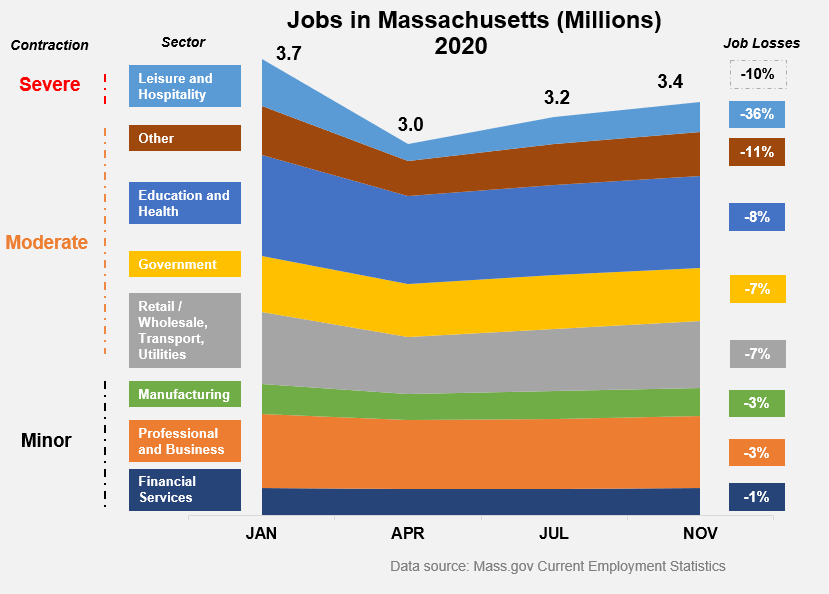
     

Leisure and hospitality, which includes Boston’s cherished dining scene, along with the vibrant arts and entertainment community, sits in a tier of economic misery on its own. The industry, which employed 380,000 residents early last year, was forced to lay off a staggering 75% of its workforce during March and April, as dining and travel restrictions came to bear against a surging virus. Over a third of leisure and hospitality workers remain unemployed even after proprietors reupped staffing through the spring and summer. The Massachusetts Restaurant Association estimated in September that 20% of the state’s eateries have closed permanently. 

The passage of recent bills in the Statehouse provides some support. In November, Governor Baker announced a $50 million economic stimulus providing relief to roughly 900 small businesses. The program received ten times as many applications. In December, Massachusetts announced a second stimulus for small businesses totaling $670 million. The latest measure, which allocates $75,000 per company, or three months’ expenses, could provide relief to nearly 9,000 businesses across the state. A balanced approach to grantmaking that views businesses through the lens of hardship while considering the company’s potential contributions to the economy is critical to maximizing the impact of the funds.

But the question remains: when will the economy go back to normal? The Massachusetts unemployment rate sits at 7% heading into the middle of winter, as the number of COVID cases remains elevated following the holidays. Assuming that hiring remains modest through the winter—10,000 jobs per month—and job gains in the spring and summer mirror those from last year as the vaccine is distributed and the state returns to a typical cadence of life—60,00 jobs per month—the Commonwealth can expect to return to pre-COVID employment levels sometime in the late summer. And for the many months in between, the degree of economic pain felt by those in the Bay State rests largely on occupation.

//

Matthew Doyle is a business development manager at L3Harris Technologies in Somerville and a graduate of the University of Rhode Island. His writing on business and the economy has appeared in The Providence JournalProvidence Business News, and The Day. Views expressed in his writing are his own. Follow him on Twitter @MatthewJDoyle_.

Vice, the New Face of Media

The Internet jabbed a knife into legacy media, and millennials twisted. Millennials are America’s largest generational cohort and consumer group. The problem is certain companies—especially the media titans—were never sure how to approach the defiant, smart-phone wielding bunch. They don’t pay for cable TV. News is a birthright, not an expense. The audacious idea that they would pay for ad-riddled television was met with cord-cutting. And only 40% of millennials pay for a news subscription. These developments are chilling to media companies and their corporate counterparts who fork over billions in advertising dollars.

It follows that a media company with the superpower to influence and engage millennials might be worth something.  Vice Media, which started as a Montreal–based punk rock magazine in the 90’s, is a household name among Gen Y. The digital media darling churns out edgy and millennial-centric news and content—from documentaries on drug use in the US to reporting on wars in far flung corners of the world—across a bevy of mediums including its websites and television station as well as social platforms YouTube and Snapchat. Over the summer TPG, the seminal buyout group, invested $450 million in Vice. The investment values the company at $5.7 billion, nearly double what the New York Times would garner in a sale today. And Vice is worth every penny.

But why is Vice the answer? Their billion dollar CEO looks like a House of Blues Bouncer. They publish lewd headlines about German sex dolls and generally possess a penchant for embracing political incorrectness. The company’s smash mouth style has done little to curb its skyrocketing valuation nor has it deterred industry incumbents like Disney and Rupert Murdoch from hurling financing at the upstart. The centerpiece of Vice’s value proposition is that it understands millennials in a deep, genuine way that mature companies both inside and outside of media do not. For the right price, Vice leverages its Gen Y savvy to help make other products cool too.

Vice’s differentiator is branded content, advertising that weaves together a legitimate, well-reported narrative about a brand or product. An example is Nike paying for a video detailing the history of its famed SB Dunks. It’s not wrong to say Vice is doing the work of Madison Avenue; Vice helps brands build an image and tell a story. From a business standpoint, Vice’s reliance on branded content isn’t a bad thing. Vice does not suffer from the illusion it will make money selling news. The WSJ reported most of Vice’s $800 million in projected revenue for 2016 would come from branded content. It doesn’t hurt that Vice has sharpened its journalistic credibility, either.  Rugged reporting assignments have included embedding a reporter in ISIS and sneaking founder Shane Smith into North Korea to film a covert video series.

Critics, including Vice’s defunct digital rival Gawker, have asserted Vice is capturing the attention of hip consumers and selling their attention to the very corporate monoliths those consumers eschew.  Shane Smith vigorously denies that corporate customers dictate Vice’s storytelling.  The truth is an investor doesn’t care where Vice’s allegiances lie. Vice has 25 million monthly visitors on its websites and access to another 25 million through sites that pay Vice to handle ad sales. In comparison, the NYT has about 80 million monthly visitors. Vice helps connect those millennial eyeballs to hip brands like Nike and unhip brands like Dell. It also teams with legacy media companies like CNN to help them get a seat at the cool table.  And for its services Vice earns $800 million a year in revenue.

Using the $450 million from TPG, Vice plans to pursue scripted programming and international expansion. However, solid reporting and lofty corporate ambitions aren’t enough to bring a media company to the Promised Land. But mix those attributes with a knack for understanding millennials, and an ability to turn that understanding into revenue, and the new face of media begins to emerge. Millennials are elusive, but their buying power is too large to ignore.  Companies, media and otherwise, must find ways to appeal to them.  For now, Vice owns the keys to the kingdom, and rightfully, a $6 billion dollar price tag.

Small State, Big Problem: Rhode Island’s Innovation Gap

In 2007 Dr. Ken Yang, an engineering professor at the University of Rhode Island, filed an application with the United States Patent and Trademark Office. Thus was the beginning of technology that would springboard VeloBit, a computer software company aimed at providing companies with speedier information processing capabilities, or in other words, faster access to data on their servers such as customer records and payroll information. Officially founded in 2010, VeloBit epitomizes a successful startup; a good idea, fast growth, and a pot of gold at the end. However the story of VeloBit is a two-sided fable. The first, certainly, is a story of innovation. The second, meanwhile, is the caricature of a state unable to harness innovation and spur economic rebound.

Ken Yang straddles the line between academia and the startup world. He has been teaching at URI since 1988 in the disciplines of electrical, computer and biomedical engineering. His Ph.D. students have gone on to work for premiere technology companies including Intel and EMC. He keeps busy outside the classroom, too, having started four companies and received ten patents during his time at URI. Those accomplishments include VeloBit, and its foundational algorithm, which improves the performance of solid state drives, a data storage component of computers. Solid state drives are increasingly popular, but at times slow. Yang’s software helped fix the problem, and did so at speeds triple that of its competitors while maintaining an affordable price tag. Ken Yang had a cash cow.

In 2010, a mutual friend introduced Yang to Duncan McCallum, a Boston-based startup guru with degrees from M.I.T. and Harvard Business School who specializes in taking small tech startups, growing them, and selling them to large technology companies. McCallum was won over during a lab demonstration where Yang proved his ability to accelerate information access using an all-software solution. The software eliminates the need for traditional more expensive hardware serving the same function, and as an added bonus, can be downloaded directly by customers via the Internet in under a minute. By the end of fall 2010 VeloBit was off and running, headquartered in Lincoln, MA with a small handful of employees including one of Yang’s former graduate students. McCallum took the helm as CEO, while Yang served as the firm’s technical backbone in the role of Chief Technology Officer.

In the spring of 2011, VeloBit landed financial backing from two Boston area venture capital firms, Longworth Venture Partners and Fairhaven Capital. Both firms focus in the area of high growth technology companies. In what is known as Round A Financing, or the first round of financing following start-up capital, McCallum stated that VeloBit received a “fairly typical A Round”  sum, which often falls somewhere in the single-digit millions. With capital in hand, the small firm began to excel, and was a dubbed a 2012 Storage Product of the Year by Storage Magazine. VeloBit’s “HyperCache” software was judged on criteria including innovation and performance. A TechTarget article noted that VeloBit was fast becoming a stand-out product in its market, despite tough competition. Growth followed. By the second quarter of 2013, VeloBit was in use across five continents with nearly 400 installations.

Amid its successes VeloBit approached bankers at Wells Fargo, and asked them to help identify firms interested in acquiring the feisty start-up. There turned out to be several. However Western Digital, the Fortune 500 computer hardware firm with the recognizable blue and white logo, was the winning suitor. On July 10, 2013, an official press release emerged from Western Digital stating that VeloBit had been purchased, and would be integrated into the Western Digital storage subsidiary, HGST. The sum was undisclosed. However an article the following day by The Register did some guesswork, concluding that the sum was likely “less than $50m and could be around $25m assuming a 5X payout on a guesstimated $5m A-round. But we could be out by a factor of two, or even more.” McCallum has stated that sale “produced good returns for investors and significant wealth for founders.”

Velobit, the brainchild of a University of Rhode Island engineering professor, is in its own right a startup Cinderella story.  Research was commercialized, contributed to society in a meaningful way, and monetized. However just as Cinderella’s stepsisters did not fit the glass slipper, there is a loser in this story too, and it is Rhode Island. The state’s beleaguered economy has long been a topic of concern among citizens and legislators. And The Great Recession did no favors. The state’s unemployment rate rocketed to 11.3% during 2009, up from 5% just two years earlier. Only recently has Rhode Island ended its nine year reign as having the highest unemployment rate in New England, while still sitting a lofty half percentage point above the national average, at 5.5%. The state has recovered only 80% of jobs wiped out during the Recession. In stark contrast, the United States as a whole has regained all lost jobs and reached that milestone nearly two years ago.

However even before the Recession, things weren’t pretty for Rhode Island. Sprawling, shuttered factories have long served as wistful and unsettling reminders of the state’s once fearsome manufacturing prowess. Business friendliness surveys are continually abysmal. For many young Rhode Islanders, this is the only setting they’ve ever seen. What heyday?  Obviously, businesspeople and policymakers have been tasked with the tough problem of how to grow business in Rhode Island. VeloBit is far from the center of the problem, but it is an apt microcosm of the state’s inability to capture a good idea and create growth. And it warrants questioning. How and why did a hot tech startup, born in a lab at the state’s sole land-grant university, sneak out the back door to Massachusetts?

In 2012, University of California, Berkeley economist Enrico Moretti wrote The New Geography of Jobs. He highlighted research showing that one high-tech job, such as a software engineer (like the ones at VeloBit), has the potential to create five more non high-tech jobs in the same city, such as waitresses or cab drivers. If the multiplier does exist, even at a multiple of less than five, it makes the Massachusetts headquartering of a tech company like VeloBit particularly painful for Rhode Island. Though VeloBit is owned by Western Digital, it is still located in, MA, now employs close to twenty people, and is growing. What if VeloBit was instead founded in Rhode Island, and currently staffing twenty people in a Providence office? Moretti’s multiplier suggests the potential for an additional hundred jobs, and Rhode Island could sorely use them.

In exchange for research support, the University of Rhode Island held a partial-ownership stake in VeloBit, and presumably realized financial gains from its sale. Though any sum can be argued a pittance relative to the potential for a successful, Rhode Island-based, job-generating company. So why exactly was VeloBit founded in Massachusetts? The answer, according to Yang, is pretty simple. Duncan McCallum was running the commercial operations of the firm, and he lives in Boston; not rocket science. As many entrepreneurs are aware, venture capitalists don’t stroll down the street doling out wads of cash to techies. Yang was fortunate enough to be introduced to a venture capitalist—someone who could help him commercialize his research and make an impact—and he wasn’t going to complain where they were based. “If the partner is here, we can do it here” Yang said of Rhode Island. “I would like to do it in Rhode Island.”

Innovative ideas should not be confined to certain geographies, nor should the money and brainpower to propel them. Today, VeloBit is a Massachusetts company, and that’s fine. However, to spur growth in the future, Rhode Island needs to do two things.  First, the state should realize that VeloBit and companies like it can be valuable assets in helping to repair a battered, sluggish economy. Say it, out loud. Second, get proactive. A culture needs to be forged, where, when someone has a good idea, there is willing partnership within the state, especially in the private sector, to help them achieve it. There have surely been other instances in Rhode Island similar to VeloBit. At this rate, there will surely be more. Where there is smoke, there is fire. We need to put it out. “We have the talent, we have the people” said Yang. “Rhode Island can be a great state to grow business.”