Category Archives: Millennials

What Does a Pandemic Do to the Economy?

The story of jobs in Massachusetts is a complex one. Just a year ago, the state’s economy roared, the unemployment rate scraped below 3%, and experts assured that if a recession was coming, it wouldn’t be anytime soon. And then came COVID-19. The virus that first made landfall in Massachusetts last February has since claimed the life of the 13,000 residents while the state has endured a series of stay at-home advisories, work from home mandates and school closures. But what does it all mean for job growth?

The year 2020 was an ugly one for the economy, and April was particularly horrific. The unemployment rate jumped six-fold from 2.8% to 16.2% as layoffs spread rapidly across the state. Spring brought promise and healing, however. The weather warmed, the virus retreated and Governor Charlie Baker initiated his four-phase reopening plan in May. From May through September, Massachusetts added an average of 64,000 jobs per month. Unfortunately, the recovery is not over. Fall and winter have coincided with a spike in infections, the pace of hiring has slowed, and the degree of economic hardship varies widely across walks of life.  

The economic impact of COVID-19 on Massachusetts is a tale of two Commonwealths. There are those who endure the pandemic’s pain, and those who do not. Oft-discussed “white collar workers”—those occupying financial, managerial and business services roles, which account for a quarter of jobs across the state—have been largely insulated against the downturn. The digital nature of desk jobs has only accelerated during the pandemic thanks to the adoption of connectivity tools like Zoom. Manufacturing jobs also rebounded strongly during the summer, and the sector is just 7,000 jobs shy of its pre-COVID employment total. Other corners of the economy haven’t been so lucky.

Education and healthcare, classified as a single industry by the Bureau of Labor Statistics, employs 1 in 5 Massachusetts workers, but shed 8% of its workforce during 2020. A slow bounce back in healthcare has been partially offset by education jobs, which have remained stubbornly flat following a 13% paring in April.  The number of retail and wholesaler jobs in the state remains 7% below its January 2020 peak; employment gains plateaued this fall following strong hiring in the spring and summer. State and local government jobs in the Commonwealth remain off by 7% from last year’s highs; the dip, likely lasting, is driven in part by closure of 2020 Census efforts. 
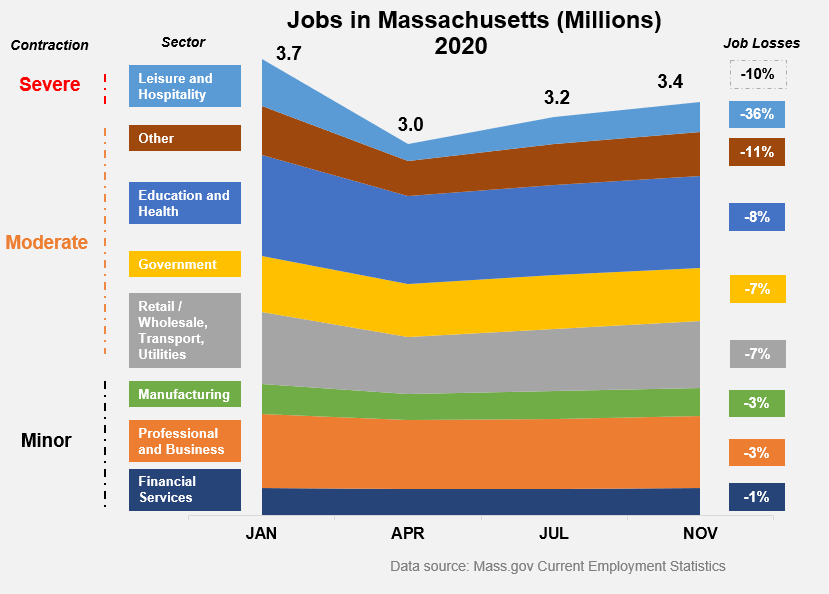
     

Leisure and hospitality, which includes Boston’s cherished dining scene, along with the vibrant arts and entertainment community, sits in a tier of economic misery on its own. The industry, which employed 380,000 residents early last year, was forced to lay off a staggering 75% of its workforce during March and April, as dining and travel restrictions came to bear against a surging virus. Over a third of leisure and hospitality workers remain unemployed even after proprietors reupped staffing through the spring and summer. The Massachusetts Restaurant Association estimated in September that 20% of the state’s eateries have closed permanently. 

The passage of recent bills in the Statehouse provides some support. In November, Governor Baker announced a $50 million economic stimulus providing relief to roughly 900 small businesses. The program received ten times as many applications. In December, Massachusetts announced a second stimulus for small businesses totaling $670 million. The latest measure, which allocates $75,000 per company, or three months’ expenses, could provide relief to nearly 9,000 businesses across the state. A balanced approach to grantmaking that views businesses through the lens of hardship while considering the company’s potential contributions to the economy is critical to maximizing the impact of the funds.

But the question remains: when will the economy go back to normal? The Massachusetts unemployment rate sits at 7% heading into the middle of winter, as the number of COVID cases remains elevated following the holidays. Assuming that hiring remains modest through the winter—10,000 jobs per month—and job gains in the spring and summer mirror those from last year as the vaccine is distributed and the state returns to a typical cadence of life—60,00 jobs per month—the Commonwealth can expect to return to pre-COVID employment levels sometime in the late summer. And for the many months in between, the degree of economic pain felt by those in the Bay State rests largely on occupation.

//

Matthew Doyle is a business development manager at L3Harris Technologies in Somerville and a graduate of the University of Rhode Island. His writing on business and the economy has appeared in The Providence JournalProvidence Business News, and The Day. Views expressed in his writing are his own. Follow him on Twitter @MatthewJDoyle_.

Quincy Center Remade: Triumphs or Tribulations

Quincy is a place of distinct character. Situated between Boston and its South Shore, the coastal city of 90,000 is a unique collision of urban and suburban influence. Traditionally working-class with pockets of unassuming affluence, Quincy’s economic roots are industrial while recent decades have seen the City’s residential complexion shift towards that of the office worker. And of course, two United States Presidents lay buried beneath its well-trodden streets.

In the middle of this landscape is Quincy Center, an assortment of city government, commerce, historical sites and private residences. After moving from Quincy as a teenager in 2009, my visits to Quincy Center were scarce. Stately and tired, it had the dinge and frenetic pace of a city center without the upside. It was anathema to name-brand retailers, short on quality dining, and without attractions beyond a shabby movie theatre. Nor was it the first place you’d want to find yourself at night. For all of Quincy’s strengths, its downtown was not one.

So, when I began to hear tales of Quincy Center’s turnaround, that it was becoming a hot spot for young people, I was intrigued. And though the changes have been well-reported, I returned recently to find the Quincy Center of old fading away. Familiar landmarks like the Bethany Congregational Church, with its menacing gargoyles, and the unremitting Granite Trust building have been joined by soaring luxury apartments and trendy eateries. There is even a greenway replete with fountains and trees on what was a congested street.

The redevelopment efforts have a clear potential to change the identity of Quincy Center and that of the city itself. Modern residential builds and a burgeoning dining scene are bringing a new sense of life to the area. Young professionals and businesses seeking cheaper alternatives to Boston and Cambridge have taken notice, and more will follow suit. On the other side of the coin however are Quincy Center’s small business community and residents, who are at risk to be trampled by the stampede. The changes afoot should be considered diligently.

Yes, there are benefits to having greater numbers of young people living and working in Quincy. A new generation brings an energy and thirst for progress not yet evaporated by thirty years sitting at a desk. And a Deloitte survey from last year found that today’s young professionals favor objectives that emphasize job creation and societal improvement to those prioritizing sales and profit. That mindset is a necessary precursor to fighting for an equitable Quincy and driving a positive approach to community development.

And to be fair, a growing corporate presence in Quincy doesn’t sound all bad either. Quincy Center, home to the headquarters of Stop & Shop, the grocery giant, and Presidents Place, which leases space to Harvard Vanguard and Quincy College, has long-possessed corporate footprints while falling somewhere short of critical mass. The center’s ongoing facelift, cheaper-than-Boston overhead and Red Line proximity might just be enough to draw the kinds innovative businesses to push Quincy through the final phase of its decades-long economic rebirth.

The revival, however, could spell trouble for life-long residents and long-time businesses of the city. Affordable housing in Quincy Center and other neighborhoods is a reported problem already, one sure to be exacerbated by an influx of high-salary professionals. Renters may be forced elsewhere, along with the city’s millennial natives, who have watched home prices double over ten years. Small businesses face a parallel concern. As demand for commercial real estate increases, so too will rent. Many colorful businesses that have long represented the upside of Quincy Center’s character—KC’s Sportscards, Nick’s Pizza, and the outlandishly painted tropical fish store—are still standing. Let’s hope they remain so.

A moment of stark contrast between new Quincy Center and old unfolded toward the end of my visit. After mazing through side streets, I arrived at the entrance to West of Chestnut, the chic and towering residential complex erected in 2016. Across the street was Sully’s—the longstanding local watering hole known for its eponymous neon signage—forlorn and shuttered. My moment of reflection was soon broken as a twentysomething darted from the apartment to collect his Amazon groceries.

Quincy Center is changing rapidly. New residential buildings, improved infrastructure, and a spate of dining establishments have roared into the downtown, creating a lively and urbane atmosphere once reserved for points north of the Neponset River. Although a young workforce and increased corporate presence carry social and economic promise, public officials would do well to push harder on affordable housing while exploring measures to protect small businesses from soaring rents.

Vice, the New Face of Media

The Internet jabbed a knife into legacy media, and millennials twisted. Millennials are America’s largest generational cohort and consumer group. The problem is certain companies—especially the media titans—were never sure how to approach the defiant, smart-phone wielding bunch. They don’t pay for cable TV. News is a birthright, not an expense. The audacious idea that they would pay for ad-riddled television was met with cord-cutting. And only 40% of millennials pay for a news subscription. These developments are chilling to media companies and their corporate counterparts who fork over billions in advertising dollars.

It follows that a media company with the superpower to influence and engage millennials might be worth something.  Vice Media, which started as a Montreal–based punk rock magazine in the 90’s, is a household name among Gen Y. The digital media darling churns out edgy and millennial-centric news and content—from documentaries on drug use in the US to reporting on wars in far flung corners of the world—across a bevy of mediums including its websites and television station as well as social platforms YouTube and Snapchat. Over the summer TPG, the seminal buyout group, invested $450 million in Vice. The investment values the company at $5.7 billion, nearly double what the New York Times would garner in a sale today. And Vice is worth every penny.

But why is Vice the answer? Their billion dollar CEO looks like a House of Blues Bouncer. They publish lewd headlines about German sex dolls and generally possess a penchant for embracing political incorrectness. The company’s smash mouth style has done little to curb its skyrocketing valuation nor has it deterred industry incumbents like Disney and Rupert Murdoch from hurling financing at the upstart. The centerpiece of Vice’s value proposition is that it understands millennials in a deep, genuine way that mature companies both inside and outside of media do not. For the right price, Vice leverages its Gen Y savvy to help make other products cool too.

Vice’s differentiator is branded content, advertising that weaves together a legitimate, well-reported narrative about a brand or product. An example is Nike paying for a video detailing the history of its famed SB Dunks. It’s not wrong to say Vice is doing the work of Madison Avenue; Vice helps brands build an image and tell a story. From a business standpoint, Vice’s reliance on branded content isn’t a bad thing. Vice does not suffer from the illusion it will make money selling news. The WSJ reported most of Vice’s $800 million in projected revenue for 2016 would come from branded content. It doesn’t hurt that Vice has sharpened its journalistic credibility, either.  Rugged reporting assignments have included embedding a reporter in ISIS and sneaking founder Shane Smith into North Korea to film a covert video series.

Critics, including Vice’s defunct digital rival Gawker, have asserted Vice is capturing the attention of hip consumers and selling their attention to the very corporate monoliths those consumers eschew.  Shane Smith vigorously denies that corporate customers dictate Vice’s storytelling.  The truth is an investor doesn’t care where Vice’s allegiances lie. Vice has 25 million monthly visitors on its websites and access to another 25 million through sites that pay Vice to handle ad sales. In comparison, the NYT has about 80 million monthly visitors. Vice helps connect those millennial eyeballs to hip brands like Nike and unhip brands like Dell. It also teams with legacy media companies like CNN to help them get a seat at the cool table.  And for its services Vice earns $800 million a year in revenue.

Using the $450 million from TPG, Vice plans to pursue scripted programming and international expansion. However, solid reporting and lofty corporate ambitions aren’t enough to bring a media company to the Promised Land. But mix those attributes with a knack for understanding millennials, and an ability to turn that understanding into revenue, and the new face of media begins to emerge. Millennials are elusive, but their buying power is too large to ignore.  Companies, media and otherwise, must find ways to appeal to them.  For now, Vice owns the keys to the kingdom, and rightfully, a $6 billion dollar price tag.

Hoodies, Handcuffs & High Finance: Martin Shkreli

The coming of age for millennials in America, or those born between 1980 and 2000, seems to have happened swiftly. They number 75 million. They have surpassed Baby Boomers as the largest cohort both in the workplace and in the country at large. While society continues to associate millennials with puberty and hooded sweatshirts, the reality is the older end of the generation is well into its thirties and far-removed from the orthodontist. As noted by London Business School, a great deal of time has been spent pondering how to best lead millennials. Conclusions point toward a determined and tech-savvy bunch with a penchant for pushing change. Less flattering diagnoses also reflect a group that is entitled, vain and not especially loyal to employers. The subjects meanwhile have proven uninclined to wait for direction.

Millennials are impactful. They run public companies, win Nobel Prizes, and get elected to Congress.  A few also go to Wall Street where, through the years, the land of iconic wealth, avarice and big deals has seen its share of robber barons. But never have the two labels—millennial and rogue financier—been so flawlessly merged into a single character, until now. Enter Martin Shkreli, the 32 year old hedge fund manager turned pharmaceutical entrepreneur arrested for securities fraud in December. While his improbable rise from have-not to high finance lends credence to millennials’ reputation as go-getters, his public persona—a greedy, brash social media troll with a knack for irritating Hillary Clinton—has done little to dispel their image as snot-nosed narcissists. Congratulations Martin Shkreli, you are the first ­­millennial Mega Villain of Wall Street.

His early life reads like Good Will Hunting with more chess and fewer street fights. A first generation American reared in blue-collar Brooklyn, Shkreli rocketed into finance, starting two hedge funds before his 27th birthday. He was quickly recognized as a formidable activist investor, known for scathing blog posts of biotech companies he was short. Soon he would reverse course. In 2011 Shkreli took “the ultimate long position”, founding Retrophin, a biotech startup with the mission to battle “rare and life-threatening diseases.” In 2012 he was afforded a spot on the Forbes 30 under 30 in Finance. For a brief while Shkreli was loved; David armed with a big mouth and a spreadsheet, destined to defeat the Goliath CEO’s of the evil drug industry. Relentlessly ambitious, adept at using technology to catalyze change and armed with an apparent desire to tackle social issues, Martin Shkreli represented the tantalizing millennial upside that, at times, signals a generation ready to right the world.

Often times, the villainous and derided do not begin the story as antagonists. Harvey Dent is no stranger to Wall Street, from the decay of Bernie Madoff’s $36 billion dollar lie to the implosion of Enron. In the early hours of December 17th, nearly three years to the day of his 30 under 30 designation, a hooded Mr. Shkreli was escorted from his Murray Hill apartment donning manacles. The arrest was not an epochal moment, but rather the punctuation on a gradual ascent to mega-villainy. Standing before a judge at the Federal District Court in Brooklyn, Shkreli appeared at ease. While brazen behavior is not a new fad among corporate crooks, his attire—a black V-neck and sneakers—was a notable departure from the four-figure uniforms of his Wall Street predecessors at battle with the law.

Despite his early achievements as the biotech boy wonder, Shkreli developed a magnetic-like ability to draw critics long before the Department of Justice came wielding a federal indictment. In 2011 Shkreli’s hedge fund, MSMB Capital, lost $7 million betting against the stock of Orexigen Therapeutics, effectively wiping out his investors. Consistent with millennial tendency to bend the truth about poor performance, Shkreli told investors that things were fine, and he had in fact doubled their money. The move put him in the precarious position of having to pony up funds he didn’t have, funds he would eventually siphon out of Retrophin. The charade lasted long enough for Shkreli to cover his obligations at MSMB, but Retrophin investors eventually caught wind of the stunt, followed by its board, who showed Shkreli the door in 2014. In true millennial form, Shkreli took to social media to vent his frustrations.

While details of his ouster from Retrophin were still unclear, TheStreet crowned Shkreli Worst Biotech CEO of 2014. Though disdain for the young parvenu was still contained largely to industry, his time in the shadows of Wall Street would be short lived. It didn’t take long for Shkreli to kick off his second entrepreneurial venture, Turing Pharmaceuticals. It was here that Shkreli set the stage for his leap to notoriety. In November 2015, Turing acquired the rights to Daraprim, a drug used to treat infections in individuals with HIV. Shkreli soon raised the price of a single pill an astronomical 5,000% from $13 to $750, catapulting himself into the crosshairs of Presidential candidate Hillary Clinton. The New York Times estimated the price hike—a practice oft-implemented by smart money-backed drug companies—could cost patients hundreds of thousands of dollars. “1b[illon] here we come”, was Shkreli’s boastful message to a colleague.

In September, Mrs. Clinton launched her assault. Clinton laid into Shkreli at a town hall meeting in New Hampshire, called for investigations into the price hike, and, representative of the fast-growing number of elderly on social media, took her 68 year-old fingers to the keyboard to serve up a shot on Twitter. Shkreli, in perhaps his archetypal act of millennial defiance, dismissed the then-Democratic frontrunner with a brief “LOL” – the three letter phrase branded into the e-vocabulary young people that rose to prominence during the time of AIM chatrooms and T-Mobile Sidekicks. BBC quickly named Shkreli the most-hated man in America, followed by The Daily Beast.  In December, to ensure he had adequately appalled all corners of American society, Shkreli purchased the lone copy of Wu-Tang Clan’s latest effort for $2 million with no intent listen to the album but rather to “keep it from the people.

Martin Shkreli began accumulating mega-villainy stature long before his December 17th arrest. His chicanery at Retrophin coming into public view was more or less icing on the cake for the millennial lighting rod. There is a likeness in his situation to that of the fallen banker, Michael Milken. The toupee-sporting Junk Bond King of the 80’s grew wildly unpopular well before his insider trading arrest, thanks to his practice of arming corporate raiders with billions of junk debt to stage hostile takeovers. Though not illegal, the takeovers were regarded as dirty corporate practice, much like the Daraprim price hike. It is as easy to imagine Mr. Milken’s bewilderment listening to a Wu Tang album as it is unlikely that he has ever owned a V-neck. The sophisticated finance scoundrel is not a new breed. Shkreli is just the latest model.

“You could go down in history as the poster boy for greedy pharmaceutical executives, or you could change the system.” Those were the words directed at Shkreli by Congressman Elijah Cummings. In a broader sense, it is advice that can be taken to heart by all millennials. They are indeed a generation capable of propelling great change. However they must ensure their tendency to cut corners does not undermine their willingness and capacity to solve problems. They must also learn strike a balance between drive and humility. Martin Shkreli embodies the paradox well. Misled investors and burdened patients lie in the wake of his intense ambitions. He remains unapologetic. Perhaps if it’s not too late, Mr. Shkreli can find his way back to square one. Otherwise, the millennial wunderkind may be facing checkmate.