
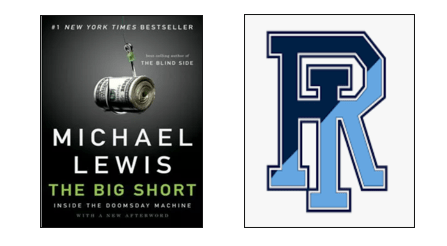
The year 2020 has been quick to provide crises of both the pandemic and social variety. But let us not allow the discomforts of fresh disasters to dampen our memories of the old ones. This year marks the tenth anniversary of The Big Short, Michael Lewis’ best-selling post-mortem of the financial crisis. The Big Short served as a sharp portrait of the financial instruments that rocked the global economy, and the characters who found fortunes in the wreckage. Likely the most insightful book on the financial meltdown, it is far and away the most entertaining.
Less obvious, though of particular interest to those in southern New England, are the book’s linkages to the University of Rhode Island. A typical state school with a predisposition towards STEM, URI ranks 166thth among national universities and has been the state’s flagship school since its founding in 1917. Its College of Business, my alma mater, is home to solid accounting and finance curriculums, and sends a healthy number of students to the Big 4 accounting firms, though fewer to banks. In a given year, however, a few students with sharp pencils and sharper elbows can typically land analyst roles on Wall Street.
To understand The Big Short’s connections to URI, it’s helpful to review the timing of some key events. Early in the book, protagonist investor Steve Eisman encounters a Deutsche Bank salesman named Greg Lippman, who comes baring a warning. Large numbers of Americans had acquired unaffordable mortgages, Lippman argued. The investment banks then took those mortgages, bundled them together, and sold them off to unsuspecting investors. When homeowners could no longer afford their payments, housing-linked securities would freefall, and the effects to the financial system could be disastrous. Lippman’s solution? Place a wager against the US housing market—through him of course—and become enormously rich.
After digging through the data, Eisman’s team found merit to Lippman’s recommendation; the housing market was teetering, catastrophe near. Steve Eisman faced a gnawing question, however. If the housing market was in deep trouble, who was foolish enough to be betting on its longevity? As it happened, other investors were asking Greg Lippman the same question, and he decided to hold a dinner in Las Vegas to help answer it. As with many stories, particularly those involving bets, The Big Short is full of winners and losers, and URI has alumni on both sides of the coin.
Tasked with managing housing linked investments for large investors like pensions and insurance companies, Wing Chau—quickly identified as a graduate of URI and Babson—was brought to dinner to play the fool. And seated beside Steve Eisman, he played the role beautifully. Chau, surprisingly to Eisman, was happy to continue betting on the US housing market. After all, his compensation was driven mostly by how much money he managed for his clients, not how well he managed it. The more assets under his purview, the bigger his fee, Chau gloated. Eisman was stunned.
Chau, who is painted as a portly purveyor of financial calamity for several pages, sued Lewis for defamation in 2011. He lost. Chau himself was sued by the SEC in 2008 for neglecting his fiduciary duties—his legal obligation to place his investors’ interests above all—and settled for a number well into the seven figures. Though the blame does not belong to money managers like Chau, exclusively. The investment rating agencies, S&P, Moody’s, and Fitch, performed horribly, too. Housing investments during this time were routinely marked as investment grade, while according to Eisman, many were anything but.
Fear not, the University of Rhode Island has a champion in the story, too. So rare was the money manager who put his chips against the US housing market in 2008 that Lewis estimated the number to be fewer than twenty. While most were based in New York City, several others were scattered across the US, including one hedge fund in Massachusetts. As Greg Lippman crisscrossed the country, trying to convince investors that things were falling apart, he made a stop in Boston and found himself across the table from a young investor named Jesse Baker.
I first came across Jesse at a career day alumni panel during my undergraduate years at URI. To be clear, he was on the panel, to dispense advice to lowly students, and I was in the audience, probably underdressed. Jesse was spectacled and—aside from a subtle barb at the fixed income specialist on the panel—quiet while awaiting his turn to speak. And when he did speak, his pedigree did most of the talking. After URI, Jesse joined Goldman Sachs, cycling through investment banking and private equity groups in New York and London, before heading to Harvard for an MBA.
Jesse was hired as a hedge fund analyst following Harvard, and shared his account of watching the crisis unfold firsthand. Sure enough, a salesman had come to the office, trumpeting notions of financial mayhem; Lippman offered Jesse’s group the same deal he’d offered Eisman, an instrument to bet against the housing market, in return for a fee. During the meeting, Lippman showed a graph of US housing prices; the trend mirrored that of real estate prices in Japan prior to the country’s devastating decline of the ’90s. After some additional number-crunching, Jesse’s team was sold. The firm went short, awaiting Armageddon, and riches.
With 18,000 students on its leafy campus, a large school like URI is bound to have alumni in the headlines for the right and wrong reasons. Of all villains, Michael Lewis chose Wing Chau—an unknown New Jersey money manager with a URI economics degree—as the poster boy for bad decision-making and misaligned interests underpinning the crisis. More improbable still, in a nation of 320 million, the number of people who spotted and bet on the housing crash is not far beyond double digits, and one went to URI. Armed with a Rhody finance degree and penchant for Excel, Jesse Baker found himself amid a short reserved for the smartest of smart money.
The Big Short’s linkages to the University of Rhode Island thread a global discussion directly into our local community while also affirming an old truth. People, financial professionals and otherwise, serve as ambassadors for their institutions, past and present.
Matthew Doyle is a business development manager at L3Harris in Somerville and a graduate of the University of Rhode Island. His writing on business and the economy has appeared in The Providence Journal, Providence Business News, and The Day. The views expressed in his writing are his own. Follow him on Twitter @MatthewJDoyle_.
 One for the Money